

Migas Touch Pickups
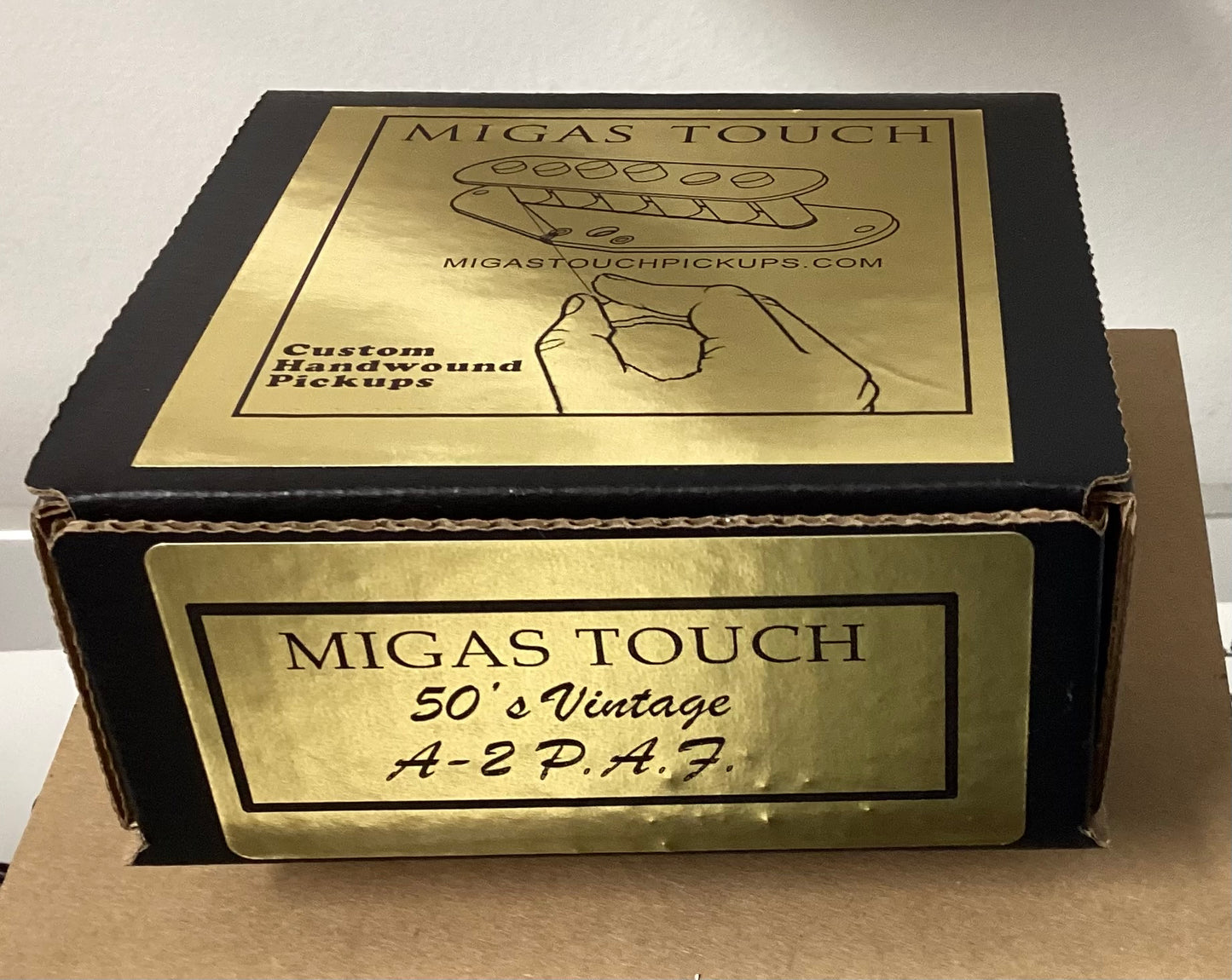
PAF Vintage 50's Spec Alnico 2 Humbucker Hand Wound by Migas Touch Pickups
PAF Vintage 50's Spec Alnico 2 Humbucker Hand Wound by Migas Touch Pickups
Regular price
$499.00 USD
Regular price
Sale price
$499.00 USD
Unit price
per
Couldn't load pickup availability
PAF Vintage 50's Spec Alnico 2 Humbucker Hand Wound by Migas Touch Pickups
Here at Migas Touch Pickups we use Vintage Spec Components made in the USA and Hand Wind our Custom Reproduction P.A.F. Humbucker Pickups. We use Alnico 2 Magnets, Plain Enamel .42 wire, mix match the winds of the coils, and use Nickel Covers. OHMs reading will vary because these are hand wound but average 7.23 for the Neck and 7.78 for the Bridge. We have recreated the golden tones of the 50's P.A.F. pickups, there is no doubt you will enjoy playing these magnificent hand wound humbuckers.About P.A.F. Humbucker Pickups:
Gibson "Patent Applied For" (PAF) humbuckers are widely considered the most influential electric guitar pickups in history. Developed by Gibson engineer Seth Lover in 1955 to eliminate electrical hum, they first appeared on Gibson guitars in early 1957. These pickups are prized for their warm, articulate, and "airy" vintage tone, which is largely attributed to manufacturing inconsistencies of the era, such as mismatched coil windings and the random use of different Alnico magnet grades.
The legendary status of PAFs stems from several unique construction details used during their 1957–1962 production run at Gibson's Kalamazoo factory:
- Inconsistent Coil Windings: Early Leesona winding machines were often stopped manually by eye, leading to uneven turn counts between the two coils. This imbalance creates complex harmonic textures and a "hot but clear" response.
- Magnet Variations: Gibson used Alnico 2, 3, 4, and 5 magnets somewhat randomly based on availability until roughly 1961, resulting in significant tonal variation between individual units.
- No Wax Potting: Original PAFs were not dipped in wax to stabilize the coils. This makes them more microphonic and sensitive to touch, contributing to a more open, lively, and uncompressed sound.
- Bobbin Colors: While most were black, a shortage of black dye in 1959 led to "double cream" or "zebra" (one black, one cream) bobbins hidden under the metal covers.
- Transition to Patent Number: After the patent was granted in 1959, Gibson gradually replaced the "Patent Applied For" sticker with a "Patent No 2,737,842" decal around 1962–1963, though many early "Pat No" pickups are identical to late